Collectors of retro video games, as collectors of all media, stand against the ravages of time's arrow. Said arrow only goes in one direction and as it inexorably pushes all forward it simultaneously leaves all behind. As the the grand philosophers in Spaceballs once posited:
Col. Sandurz: Now. You're looking at now, sir. Everything that happens now is happening now. Lord Dark Helmet: What happened to then? Col. Sandurz: We passed it. Lord Dark Helmet: When? Col. Sandurz: Just now. We're in now now. Lord Dark Helmet: Go back to then! Col. Sandurz: When? Lord Dark Helmet: Now! Col. Sandurz: Now? Lord Dark Helmet: Now! Col. Sandurz: I can't! Lord Dark Helmet: Why? Col. Sandurz: We missed it! Lord Dark Helmet: When? Col. Sandurz: Just now! Lord Dark Helmet: When will then be now? Col. Sandurz: Soon.
Summer Carnival '92 RECCA is an impressive shoot'em up. As I played it, I wanted to know more about the Summer Caravan that spawned it. So here's a bit about summer gaming competitions, including Hudson Soft's All-Japan Summer Carnival and Naxat's Summer Caravan. Plus a review of RECCA.
As video games become an aging hobby, it becomes more difficult to grasp the beginning of its tale, or the history and growth of it in general. This does not just mean its actual history, but also its dominant theories of design. For example, when many gamers talk of role playing games, only two dominant styles are generally brought up: The consolized Japanese designed role playing games, and the historically more mechanically complex and open, Western designed role playing games. Despite the fact that these two schools of design are considered different enough to be easily categorized, they share a common ancestor in tabletop games, specifically Dungeons and Dragons. While Dungeons and Dragons has been around since the 1970's, it has evolved and is almost unrecognizable in comparison to its earliest version, as the company that originally created the game went bankrupt, was bought out, and its creator has passed away.
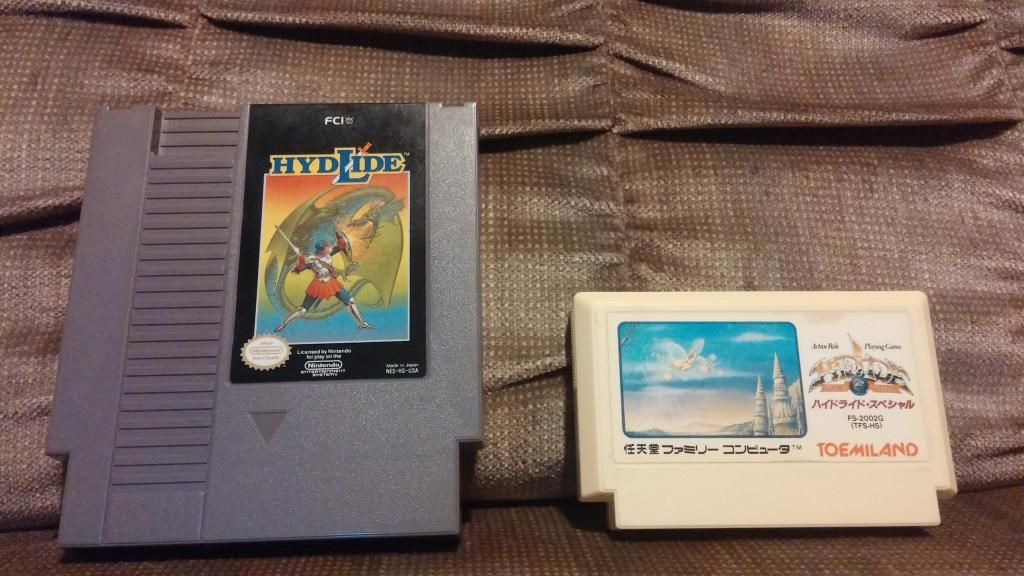
Enter 1990 (maybe early 1991). Hot from months of playing Final Fantasy (my introduction to the genre), I needed a new RPG to play, but I found my funds seriously lacking. So what do I turn to? The small wall of $20 games at the local game store. Of that lean selection of 15 or so games, there was one that caught my eye, with a description of "Action fantasy role playing" on the back of the box. With a joy that only children with extra funds can know, I bought Hydlide, unaware in the slightest the impact this game would have on my life as a gamer.
Oh, hi! A lot of birthdays happened lately, so I'll have to be short.
November 19, 1998 (10 years ago): Half-Life is released (on PC; the updated PS2 version appeared three years later ).
I hope I don't have to explain as to why this is important: it is a very fun FPS game. It also has a very fun sequel, lots of spin-offs and expansions, and about a zillion mods. Back in '98, Valve managed to make a shooter which was cinematic, and yet didn't have a single cut-scene in it. If you missed it, or lost your disk or something, Steam has it right now for $0.98 (that is 98 CENTS). For best enjoyment, use the original version (not the Half-Life Source), but do install the High Definition Pack (paste this url into your browser with Steam running, no quotes: "steam://installaddon/halflifehd").
Also, some day we may have a very updated version of the original game thanks to the guys at Black Mesa Source. With the help of supportive community, those awesome people spent the last three years or so converting the original Half-Life into Source engine (as in fully, and not just the water, like in Half Life Source). Before you say "what's taking them so long", go and check out their screenshots and such. Be amazed.
November 15, 1996 (12 years ago): Tomb Raider is released.
Consoles: Originally Sega Saturn, then Sony PlayStation, MS-DOS, and later others.
It was 12 years ago. Lara Croft, later hailed as the most recognizable female video game character, became known to public, and conquered hearts of millions (in part due to the game designers fooling around and enlarging Lara's breasts to 150% size, and then deciding to leave it that way). She could be seen on magazine covers, computer backgrounds, posters, and even TV. People fell in love with her... All in all, she was a female Indiana Jones (only with Harrison Ford replaced by a hot acrobatic babe).
The plot (just like the plot of almost any game in the series) was not anything particularly amazing - Lara finds an ancient artefact, realizes that there are more, but before she can find them all, someone evil uses the artefact's power and turns himself/herself into a mutant/dragon/spider/etc. for Lara to deal with. Also, at some point during any story, Lara absolutely must be stripped of all her weapons (not clothes) so that she can has fun recovering them while defenseless (a recurring story element).
What really attracted people (besides the protagonist herself) was the gameplay. A combination of traditional platform action (similar to Prince of Persia), cutting edge 3D graphics, the revolutionary third-person camera, gun action, and simple but clever puzzles is what made Tomb Raider famous (and, by extension, what raised PlayStation's popularity in its early years). The series continued with the hit TR2, improved graphics for TR3, and while TR: The Last Revelation brought the Egypt locations back, TR: Chronicles and Angel of Darkness disappointed many fans, and some feared that the series may be dead. It was not until recently when Core Design handed over control to Crystal Dynamics, which resulted in the true revival of Lara in TR: Legend, a remake of the original called TR: Anniversary, and the new title, TR: Underworld, about to be released (three days left).
Anyway, celebrate this day by playing the games from the series. I myself have many fun memories. Remember, in the second game, how Lara had to outswim a shark deep underwater? Or how in the third game she had to infiltrate Area 51? How about pig-tailed 16-year-old Lara running around a really creepy Irish village in Chronicles?
If you are going to play the Saturn or the PlayStation version, remember that you can only save using "save crystals". And if you are going to run the DOS version, you'll need to do a few tricks first (Windows XP and Vista will not cooperate). For any help running the game, as well as awesome walkthroughs, visit Stella's awesome site (I owe her a lot): http://www.tombraiders.net/
October 20, 1985 (23 years ago): Sega Mark III is released in Japan.
Known later as Sega Master System, Sega released SMS to compete with the NES. The console supported a number of accessories (like a light gun, 3D glasses, and at least 4 different varieties of controllers) and featured a number of successful games (Phantasy Star is a big one, other popular ones were Y's: The Vanished Omens, Alex Kidd in Miracle Worlds, Outrun and the later Sonic the Hedgehog port). The system also had ports for both cartridges and cards, though cartridges were more common.
Nevertheless, the console was not successful: in North America it was eclipsed by NES, and later by Sega's own Genesis; in Japan, both Famicom and PC Engine were much more popular. The later, smaller revision, called SMS II, did not help sales. I am actually surprised that SMS had a game released for it in Europe as late as 1996. If only Sonic would've appeared sooner, the SMS might've had a chance.
September / October, 1982 (26 years ago): E.T. The Extra-Terrestrial is released for Atari 2600 (Sources are unclear on exact release date).
October, November, December 1983 (25 years ago): North American Video Game Crash of 1983 begins due to the market flood of poorly made software.
E.T. The Extra Terrestrial is one of the most famous games ever made, mostly because it is also one of the most poorly made and over-produced games. The reason for the rushed development and overproduction is clear: the movie of the same name was an instant hit, and became the most financially successful film at the time of its release (yes, surpassing Star Wars). It only made sense to think that a game based on such a hit movie would become a bestseller, so Atari reduced development time to only six weeks, skipping audience testing in the process.
Certainly, E.T. was not the only reason for the subsequent Video Game Market Crash; there were other low-quality games made around that time (the terrible "flickering ghosts" port of PacMan comes to mind). Imagine how confused parents must have been, deciding on which console to buy: Atari 2600, Atari 5600, ColecoVision, Intellivision, Astrocade, Odyssey 2, Fairchild Channel F, to name a few, and that is not including Sears clones or other, more obscure consoles. Other contributing factors for the crash were an abundance of start-up companies trying to make some cash and hoping that customers would buy any video game regardless of how bad it was, as well as the availability of cheaper and usually more versatile computers, such as TI-99 and Commodore VIC-20.
Most important effects of the crash were: - End to 2nd generation of video game consoles; - Slowdown of the video game hardware development; - Many third-party game development companies shutting down, including Coleco and Magnavox; - Activision taking years to recover; - Atari never recovering from the blow and eventually leaving video game hardware business; - Almost complete lack of retailers' and customers' interest in Video Games for several years afterwards; - Resurrection of video games industry by Nintendo and its NES (note that it is called an "entertainment system", not a "console"); - Beginning of Japanese video game domination, primarily by Nintendo and Sega; - Introduction of strict rules regarding licensing third-party made games.
In my own opinion, the E.T. game is terrible. Should a person unfamiliar with the movie play this game, he/she might think that the movie consists of E.T. walking around places with many, many deep holes in the ground, constantly falling into them, slowly "levitating" out of them, just to fall back in, and again, and again. If you are one of the fortunate ones who never played this, ask your Atari-loving friend (I am sure he has this game somewhere) to let you play, just for educational purposes.
September 30, 1997 (11 years ago): Fallout is released.
September 30, 1998 (10 years ago): Fallout 2 is released.
Consoles: Windows PC
If you have not played either of these RPG titles, you should at least try. Set in a violent post-apocalyptic future, Fallout games stood out with their dark humor, art-deco designs (many items and technology the player encounters are from the 1950's), and themes meant for more "grown-up" audiences (plenty of 'casual' language and blood). The player explored the world in real-time, while combat was turn-based and used "action points" (like in the awesome X-COM: UFO Defense). Many balanced skills made it actually possible for the player to rely more on stealth, or diplomacy, instead of force. Furthermore, the quests often had multiple outcomes, granting varying experience and affecting the player's karma. As for myself, I was glad to see an RPG that did not have any elves or magic, but instead lots and lots of guns, which I liked. The art direction was another thing I liked, as well as many pop-culture references (like a card game called "Tragic: The Garnering", or the Nuka-Cola drink).
As I am sure many of you know, after shutting down Project Van Buren, a Fallout sequel in development, Bethesda purchased the rights to the franchise from Black Isle and is about to release a sequel of their own, Fallout 3, on October 28th of this year. I know that I will buy it, play it, and hate it, but continue playing it. I could go on a rant about Bethesda and their "experience" in game-making, but there are other sites on the Internets for that.
To reminisce, here is the opening video from Fallout, along with the awesome music ("Maybe" by The Ink Spots) and narrated by Ron Perlman:
September 26, 1986 (22 years ago): Akumajo Dracula is released in Japan.
Alternative names: Castlevania, Demon Castle Dracula.
Consoles: Initially Famicom Disc System and MSX2 in Japan, later NES and others.
Heavily influencing the platformer genre in the late 80's, this vampire-themed game is one of Konami's most famous series. The original game is about some Simon Belmont, who disliked vampires for whatever reason, and particularly wanted to destroy Dracula (every vampire hunter's dream). Using his whip along with other awesome weapons (including a Bible and a flying cross), Simon battled through hordes of Dracula's minions in a demonic castle (hence the title), occasionally stumbling upon an angry horror movie cliche as a boss fight.
Throughout the sequels, gameplay underwent significant changes. RPG-type features were introduced in Castlevania II: Simon's Quest, and removed in Castlevania III: Dracula's Curse. The RPG elements were brought back about ten years later, although in a different form, for one of the most popular titles in the series, Castlevania: Symphony of the Night. A surprise PlayStation hit during the era of 3D games, two-dimensional Symphony featured a completely reworked art style (influenced by Gothic and Baroque styles) and complete exploration freedom.
The franchise went on to make at least 24 (!) video games, with a couple more to be released soon. A motion picture based on the games was also promised, but after 3 years of planning, multiple script revisions, and a writers' strike, this possibility is somewhat dim.
I am very glad I stumbled upon this wonderful website - I found out about it while searching for a book called Video Game Bible. Not only the site features one of the biggest game databases on the web along with built-in collection tracking software, it doesn't even have any ads! How often do you see that on the web nowadays? I thought that this website deserved a donation, and if you can spare even a dollar, you should too (the link is here).
I am sure every one of us has some pretty old games in the collection (this is why you are here, right?). Well, I thought we may as well acknowledge memorable games by celebrating their birthdays! And this is why I have this feature. To narrow the scope, I will only post about games that were released after the crash, but are at least 10 years old (I think ten years is enough to realize whether a game has left any influence in the world of video games). I will also explain why this game is important enough to mention. ===================================================
September 24, 1993 (15 years ago): Myst is released.
Console: Macintosh initially, many more soon after.
While hailed by some as a "fancy collection of really obscure puzzles" or "interactive slide-show" (they may be right!), the popularity of the game could not be questioned. Myst eventually sold over 6 million copies, a record it held for almost 9 years, until the arrival of The Sims. The release of Myst also largely helped adopt the CD-ROM format on personal computers, since the game fully took advantage of the format with tons of images and music. Myst spawned four well-selling sequels, as well a couple of remakes, some spin-offs, and many imitators.
In my personal opinion, I would attribute the popularity of Myst to first-person view combined with realistic graphics (something first-person games of the era could not yet pull off), making the game very immersive, while the puzzles and lack of violence made it appealing to people who would not normally play games (even "moms" played it in the early 90's).
See also: If you liked Myst, then I would recommend horror adventures AMBER: Journeys Beyond (1996), or the much later Scratches (2006), as well as many other mystery games spawned by this style.





 Oh, hi! A lot of birthdays happened lately, so I'll have to be short.
 November 15, 1996 (12 years ago): Tomb Raider is released.
 October 20, 1985 (23 years ago): Sega Mark III is released in Japan.
 September / October, 1982 (26 years ago): E.T. The Extra-Terrestrial is released for Atari 2600 (Sources are unclear on exact release date).
 Most important effects of the crash were:
 September 30, 1997 (11 years ago): Fallout is released.
 September 26, 1986 (22 years ago): Akumajo Dracula is released in Japan.