|
Condemned: Criminal Origins

Its been a while guys, sorry about that. Life sometimes interferes, but there is lots more horror goodness I haven't yet shared that needs to be played, both retro and not. And in this case, this games not...though admittedly it might as well be due to its release date.
Condemned: Criminal Origins was developed by Monolith Productions and published by Sega, releasing to the masses as a Microsoft Xbox 360 launch title. Actually, that is not entirely accurate. Condemned actually preceded the 360s release, coming out on Nov. 15, 2005, which means its older than the oldest console in this generation (the 360s official launch date was Nov. 22, 2005, in the US). Of all the 360 launch titles, this was the one that generated the biggest personal interest and was my first game purchase on the console, though admittedly I bought the machine specifically for Dead Rising. I'm glad I picked up Condemned by itself, as I managed to give it the time it truly deserved.
Condemned is an interesting approach to the traditional survival horror. While it visits the same dark locales and features what is effectively a supercop as the main protagonist a la Resident Evil, this guys a little different. Ethan Thomas is tough, has highly 'acute senses, and goes after a particularly disturbing type of criminal: serial killers. Ethans disturbingly good at this, but it seems it comes with a price that Ethan doesn't even know must be paid, and his life is not exactly as it appears. Early on in the game he finds himself up against a similar individual on the other side of the law, a super serial killer labeled only Serial Killer X who hunts his own kind and kills them based upon their own methods. Unfortunately for Ethan, X gets the drop on him, steals his gun, kills two cops with it, and knocks Ethan out a window before escaping. Ethan wakes up in his apartment with family friend Malcolm Vanhorn, who warns Ethan that hes now wanted for the murder of those policemen.
[img width=390 height=246]http://criticscorner.weebly.com/uploads/6/0/0/0/600001/5925765.jpg[/img]
So Ethan must now evade the police, take down X, and prove his innocence. To do that, he'll have to crawl through every nasty back alley and condemned building in the city while hunting for evidence. Sounds simple, right? But there are a couple of problems: it seems the city's homeless are becoming increasingly violent while creatures and events are beginning to appear around him which are twisted enough to make Ethan question his sanity.
While the plot gives a reason for all of the bizarre occurrences and gives a reason for the hordes of angry and freakish individuals you'll find literally bludgeoning each other to death with whatever they can find, its unfortunately not very coherent. Ethan has some similar qualities with the character Will Graham from Thomas Harris book Red Dragon. In Red Dragon, its hinted that Graham might easily have become the same type of monster that he hunts so easily; Ethan suffers a similar problem. The issue comes in presentation: much of the story goes unexplained unless the player bothers to read the loading screens between levels and manages to piece them all together. And even then there are several important points which the game never quite gets out, such as exactly what the character known only as The Hate actually is or where it came from. It takes the sequel to really find out whats happening, and the sequel, well, that's a discussion for another day. There are scenes where Ethan has to use his police equipment to investigate crime scenes, but as per the norm with television forensics units, it happens absurdly quick and relatively easily. Its a nice little touch that helps break up the action, but its not very realistic, so if this happens to be a pet peeve of yours about police dramas, you've been warned.
Anyway, Condemned: Criminal Origins features a very different perspective from most survival horror titles; its entirely first person, though not a true FPS. While you do find guns, they're few and far between, are limited to the amount of ammunition you find in them, but are also realistically powerful. Some enemies also carry guns, which are subject to the same rules. Fight an enemy with a revolver who fires off two shots, and the gun will come with only 4 rounds. Ethan does have a handy rechargeable taser, but its primarily for stunning and does little damage. Still, its great for thinning a crowd. Most combat revolves around melee, and Ethan's quite resourceful, so he makes a point of arming himself with just about anything he can find: locker doors, old signs, sledgehammers, mannequin arms, metal pipes, fire axes, loose boards, paper cutter blades (a particular favorite of mine), electric conduits, if it can be pried off the wall and used to bash in someones skull, Ethan is willing to use it.
[img width=400 height=300]http://2.bp.blogspot.com/_s4nTEmqXngQ/S72MqfeNgAI/AAAAAAAABF8/FAor1zy1CFQ/s1600/s26690_pc_64.jpg[/img]
But then again, so will the hordes of enemies between him and the truth. Enemies will break off a fight long enough to pry a board or rip off a street sign to beat down you or each other with. The AIs actually not bad, with enemies taunting you, breaking off to run away when hurt, and hiding in corners or behind doorways while they wait for you to pass so they can ambush you. In one particularly fun but scripted scene, a bum charges you from behind with a monkey wrench, and you only see him coming because you're looking at a bathroom mirror at the time.
To add to the combat, while there's no combo system, there is an execution system, which involves grabbing an opponent who has fallen to his knees and using whatever you have to smash in his face, snap his neck, or whatever else you happen to do. It even zooms in on their faces so you have to look them in the eyes before you curb stomp them. Its not a pleasant feeling.
Condemned is also very dark and dreary. There really aren't very many clean locales you'll visit, instead hitting up subways and sewers, a dilapidated school, an old house out in the country, or even my particularly favorite level, an abandoned shopping mall that's been overrun by squatters which dress like mannequins so they can get the drop on you from store displays. Its a terrifying feeling to walk into a display room and see one obviously bating you at the far end, because you can't be sure which mannequins in the room are real, and which ones are murderers pretending so they can lash out at you from behind.
[img width=500 height=313]http://img690.imageshack.us/img690/2382/83385883.jpg[/img]
There are also unlockables, based on messing with TV sets and collecting bird corpses and metal plates stuck to the wall and surrounded by charcoal drawings of eyes starring at you. It adds replayability to the game, which is good as its not too terribly long.
I had a lot of fun with Condemned: Criminal Origins, and when I am asked about modern survival horror, its always a title I heartily recommend. The controls are excellent, the combat felt quite good once I got the hang of it, and the environments were solidly put together and delightfully creepy. But it is not easy to get through at times, with its convoluted and mishandled plot, unrealistic forensics, and its overemphasis of violence. The game was actually so violent, it has since been banned in Germany, with all copies confiscated. Seriously, its illegal to possess or sell it, similar to Manhunt 2 in New Zealand. For the rest of us, its thankfully pretty cheap, generally going for less than $10 on eBay.
[img width=570 height=321]http://clutch.mtv.com/wp-content/uploads/2010/10/condemned-criminal-origins.jpg[/img]
For those interested, here's a taste, the intro video from the level Bart's Department Store:
Extermination
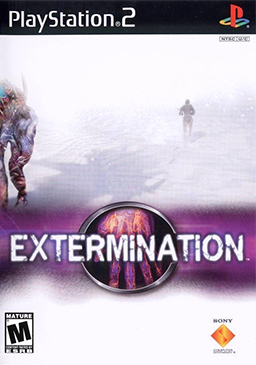
It's October again! And that means horror gaming! While noiseredux is really going above and beyond the call of duty with his excellent blog, with an ongoing featurette for this month covering the console and handheld world of horror, I figured I'd offer him some backup with another entry on that most terrifying of genres.
Extermination has the honor of being the first survival horror title released for Sony's PlayStation 2, beating out Silent Hill 2 by several months and Resident Evil: Code Veronica's PS2 port by just two weeks with its March 8, 2001, NTSC-J release date. The title was published by Sony Computer Entertainment and created by a team of developers that included several creators of Resident Evil. Reminiscent of the genre's flagship title and games like Carrier, the game has also drawn comparisons to the films The Thing and The Abyss.
[img width=400 height=300]http://www.vandal.net/previews/images/psx2/extermination/imagen6.jpg[/img]
The story revolves around Dennis Riley, a Sergeant in the USMC Special Forces Recon. Riley is one of a team being sent to infiltrate Fort Stewart, a secret research base in the Antarctic which formerly housed some of the United States' nuclear stockpile. With the end of the Cold War, the installation was converted into a research & development facility. As Riley's team approaches Fort Stewart via airplane in an ice storm, they receive a distress call from the base requesting it be the target of an air strike. But before they can respond, the plane malfunctions and crash lands, spreading the marines across the base. Riley and his combat buddy Roger Grigman are then forced to sneak into the base and meet up with the team.
While the Marines in the game come off as ballsy bad asses, the dialogue ranges from decent to absolutely terrible, and the quality of voice acting fluctuates throughout. Riley's voice is particularly bad, and at times he sounds like a whiny high school kid. The subplot involving his dead friend Andrew and Andrew's girlfriend Cindy also feels tacked on and unnecessary.
Riley must navigate the facility, facing strange mutations and living water puddles with his modular SPR-4, or Special Purpose Rifle. That weapon represents one of the most interesting elements of the entire game: instead of finding new guns to use, the player instead switches out attachments on the fly, so your weapon can always suit your situation if you have the parts. And those parts range from a sniper scope to an underslung grenade launcher, a forward grip with flashlight, enemy detector, night vision scope, and much more. The player can also switch between single round and 3-round-burst firing modes.
The ammunition system is also innovative: an infinite amount of ammo is found in dispensers through the facility, but only a limited amount can be carried, based on the number of magazines Riley happens to be carrying. If you want more ammunition, find more magazines scattered throughout the base. But the dispensers will not give ammunition for the variety of modular weapons to attach to the SPR-4, so once you're out of grenade rounds, shotgun shells, napalm juice, or whatever else you're using, you're out.
[img width=582 height=449]http://image.gamespotcdn.net/gamespot/images/screenshots/e3_2001/vg/extermination/extermination_790screen001.jpg[/img]
Adding to the action emphasis, the game features the use of a laser target, four years before Resident Evil 4 would implement its usage. And while The Ring: Terror's Realm predates Extermination with its laser sight by slightly over six months, Extermination offers far better control. Players can aim in third person perspective, moving the pointer around until it passes over a creature, generally auto-aiming at that target. But those that want to go for more precise shots can also enter a first person perspective which doesn't feature auto-aim. Unfortunately Riley can't move when his weapon is raised, and the sensitivity is too low to make it a truly effective tactic in close corners, but it's a great means for popping enemies from far off. The game also features two knife buttons, resulting in a slash or a stab, which don't require the weapon to be raised.
While this sounds like a good design on paper, it does suffer from some serious flaws. First, enemies are bullet sponges. Though that's not so bad considering there's ultimately infinite ammunition, dispensers are few and far between. To make up for this, enemies have glowing weak points that can be hit to drop them faster. Unfortunately they were designed to be hard to hit, and the third-person auto-aim feature does not automatically target them, making it difficult to kill some of the tougher varieties of mutants at close range. Aiming with the knife can also be difficult, so slashing minor enemies at one's heels can be a pain.
The camera also doesn't help as it can't be effectively manipulated, so the player can't swing it quickly to look around the corner or see an enemy right behind him. Instead, the player must turn and then either raise their weapon or press a button to center the camera behind them, wasting precious time.
[img width=582 height=449]http://image.gamespotcdn.net/gamespot/images/screenshots/e3_2001/vg/extermination/extermination_790screen004.jpg[/img]
The game's health system is also interesting, though cumbersome. The player has health, based on a 100-point numerical value, and an Infection rate. Every time an enemy hits the player, their infection goes up while their health goes down. And most healing items will not lower one's infection rate. Instead, the player must use vaccines to bring down infection, and the field-use variety aren't very common. If Riley's infection rate hits 100%, his max health decreases from 100 to 60, he takes damage over time, his character model changes, he starts taking damage from sources that previously didn't hurt him, and he can only be cured by using the MTS vaccine, which can only be administered at MTS beds...so if you wander too far from one and become infected, you won't make it back.
Extermination also features an unusual save system, revolving around battery power. Forget the ink ribbons of yesteryear, save stations now require batteries, which can be recharged at special power stations similar to the ammunition dispenser. And larger batteries will be found throughout the facility, so don't sweat saving. It's also a good idea to save often, as the game doesn't allow continues. Die, and you must reload.
[img width=640 height=480]http://ps2media.ign.com/media/previews/image/extermination/extermination05_640w.jpg[/img]
Extermination is a decent game with some solid ideas that never really rises to greatness. Horror fans who enjoy such titles as Resident Evil, Carrier, Dino Crisis, The Thing, or non-horror games like Syphon Filter and Metal Gear Solid will likely appreciate this game more than those looking for experiences similar to Silent Hill, Fatal Frame, or Haunting Ground. It's something I would recommend to players who have experience with the genre's big names and are looking for something more obscure. And while its ideas aren't always successful, they are interesting enough to warrant a look. Another nice perk is the game's low price tag: not including shipping, it can be found on eBay for as little as $2.
For those interested, here's the introduction to the game:
Call of Cthulhu: Dark Corners of the Earth
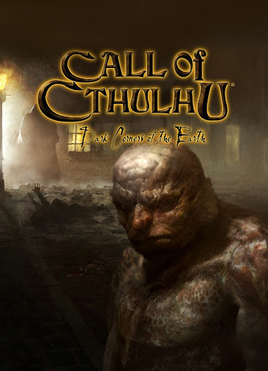
Incorporating elements of various H. P. Lovecraft tales, especially The Shadow Over Innsmouth and The Shadow Out of Time, this game for Xbox and PC from Headfirst Productions focuses on a town in the thrall of perverse worship to an alien Elder God. While it bears the Call of Cthulhu moniker, the story focuses more on Dagon, the Deep Ones, and the humans who follow them. Numerous other creatures from the Cthulhu mythos also appear.
For those of you unaware, the Cthulhu mythos is a loosely formed mythos surrounding a pantheon of ancient slumbering gods created by author H. P. Lovecraft and linked together and expanded upon by such fans and later writers as August Derleth, Stephen King, and Neal Gaiman. Lovecraft lived and wrote through the 1920s and early 30s publishing short stories and novellas in such magazines as Weird Tales. His stories tended towards archaic language concerning man's place in the universe: the species is unimportant and survives only at the whim of the ancient and slumbering Elder Gods, who would devour the souls of humanity and enslave or unmake the universe if they ever awoke from their slumber. Bizarre and twisted creatures populate his stories, along with colorful descriptions of madness and horror. And Dark Corners of the Earth is no different
[img width=410 height=307]http://www.itreviews.co.uk/graphics/normal/games/g236.jpg[/img]
In DCotE, you play as Jack Walters, a private detective in the 1920s recently released from Arkham Asylum, where he'd been held for a case of amnesia, multiple personality disorder, and schizophrenia after a police raid he was a part of went haywire and he witnessed events and beings that shattered his mind. To top if all off its hinted that Walters is psychic and unknowingly uses that ability to solve cases. He takes a job searching for a missing grocery store clerk named Brian Burnham. Burnham ran the First National grocery store in Innsmouth, and so off Jack goes to find the lad. That's when everything goes out the window. Innsmouth is not a nice place: the locals are hideous and unfriendly, the innkeeper has a preference towards knives, and there's a weird temple in the center of town. It all goes downhill from there.
Soon after, Jack will find himself racing through the Innsmouth streets, battling his way out of dank sewers, sneaking through harrowing temples, and in a variety of other locations. Fans of the Cthulhu mythos will not be disappointed as bloody cult rituals, abberrant beasts, and twisted gods all find their way into the game. There are also numerous memorable scenes that will have horror fans shaking in their chairs, and the sequences where Jack is being chased are adrenaline-fueled and nothing short of exemplary.
[img width=500 height=418]http://3.bp.blogspot.com/_F1bJubBIIwE/S7DQtCjQfnI/AAAAAAAAAPY/GCGVrB2HRL0/s1600/What+%27re+ye+lookin%27+at.jpg[/img]
The game is played in a first person perspective and features some gun combat, but it keeps a heavy focus on puzzles. And when there is something to shoot, the player is usually running the opposite direction anyway or trying to sneak past. Firearms aren't used at all throughout large portions of the game. The game also doesn't feature a HUD, instead relying on visual and auditory cues to tell the player how much damage they've taken. DCotE features a cumbersome health system in which specific items are needed to treat specific types of wounds, and wounds can appear on various parts of the body. Break a leg and you'll have to splint it, or else you'll only be able to walk at a crawl. Lacerations will have to be sutured, poison must be medicated, so on and so forth.
Then factor in a sanity system where Jack's vision blacks out and he begins hearing strange voices and other unusual sounds when he sees something that his mind can't handle, and you've got an interesting experience that can also end up a little frustrating. With madness comes changes in control sensitivity, visual distortions and fading colors. If it proves to be more than Jack can take, he goes mad and kills himself.
[img width=500 height=358]http://www.cheatcc.com/imagespcb/callrev4.jpg[/img]
Gun combat is also more realistic in Dark Corners of the Earth than in most FPS. First, ammunition must be conserved because it's extremely limited as per the norm with survival horror, so even when the player does have a gun, it doesn't mean he can fight. Second, there is no targeting reticle, so players must use the iron sights to see what they're shooting. And no matter what, the gun fires bullets wherever it's pointing. Pull out a gun and fire in the middle of the motion, and the bullet will fly in whichever direction the barrel pointed, even straight up.
While the game was generally favorably received, it is known for being extremely buggy, and some bugs will break the game. My first time playing, I ended up stuck and reverting to a previous save because a switch refused to activate. Other players have reported similar problems at different times, and there are no official patches to fix them. Nor will there ever be an official patch, as Headfirst Productions went defunct less than a year after the title's release. However, unofficial mods have been released for the PC version that help stabilize the game.
[img width=400 height=300]http://xboxmedia.gamespy.com/xbox/image/article/593/593197/call-of-cthulhu-dark-corners-of-the-earth-20050303003401733.jpg[/img]
Two sequels were planned, but both are now Vaporware.
For those of you interested, here's the intro video:
The Ring: Terror's Realm
[img width=420 height=418]http://www.coverbrowser.com/image/dreamcast-games/150-1.jpg[/img]
Yeah, it's been a little while since I updated this. I apologize about that. So to herald my triumphant return to discussing the joys of horror gaming, I present you with a title so horrific and so foul that I must beseech you, nay, get down on my knees and beg you never, ever, ever to even consider playing it!
No, seriously, this game is terrible. Not only do I enjoy horror, I also can enjoy a horribly made game from time to time. I believe it's something to do with an almost kitsch value to it that makes it unique and allows me to laugh at it. The Ring: Terror's Realm did its best to go above and beyond anything I had ever experienced. I have beaten the title, and I can honestly claim that it is not only a bad game, it is the WORST game I have ever played. And I own Pit-Fighter for the Super Nintendo.
But I suppose an explanation is in order. The Ring: Terror's Realm is a Dreamcast game based upon the Ringu property, albeit an extremely loose take on it. The game follows Meg Rainman as she starts work at the Center for Disease Control following the death of her boyfriend Robert, who was also a CDC employee. Once at work, she begins exploring and investigating a strange computer program called RING, which apparently leads her into a strange and horrific virtual world where mankind battles it out in abandoned buildings against strange monsters.
[img width=700 height=466]http://www.goodcowfilms.com/farm/games/screenshots/the-ring-dreamcast/the_ring_screenshot9.jpg[/img]
I'm sorry, did I say monsters? I mean gorillas, cat things, and strange goblin-looking critters of various colors. And when I say abandoned buildings, I mean the CDC building. Yes, that is a bit of a spoiler, but you don't really want to play this game, so don't worry about it. The monsters don't really do much beyond running up and attacking you, which they have a nasty habit of doing at a rate that will prevent you from getting a round off if they get too close. They also randomly float in the air and drop down on top of you...I think that was more of a bug that never got resolved when the game was created. At least I hope it was.
To fight these critters, Meg has an arsenal of various weapons she will acquire, all fitted with laser sights, so you can aim at critters across the room, if you can see them with the fixed cameras and if they're standing upright. Perhaps the greatest point in the game's favor, at least in my opinion, is that Meg's also not a total pushover. She can fight while unarmed, knocking the monsters away or kicking them, which is especially useful on the cat creatures.
And then there's the graphics...
[img width=400 height=300]http://diehardgamefan.com/wordpress/wp-content/uploads/2009/09/Ringsc03.jpg[/img]
...but I won't be too critical of them. I feel its appearance is out of place for a Dreamcast title, but we are retro gamers. Games don't have to look spectacular for us to enjoy them. Just understand that people look blocky and move in unnatural means, and the textures are bland and repetitive. And creature movement isn't any better. There are some nifty mechanics with enemies having a difficult time detecting you in the dark, but it rarely comes into play.
As for the sound, there's only a handful of musical tracks, and these usually consist of five, maybe six notes in a sequence before repeating. It quickly becomes nauseatingly repetitive, and the creature sounds feel off. The voice acting is also some of the absolute worst, with the random friend who appears in the intro video earning my choice as the worst actor ever. The only saving grace is the sound at the starting menu of the game, where confirmations reward the player with the most satisfying squishing sounds I've ever heard. I broke into peals of laughter every time I heard them.
[img width=700 height=466]http://www.goodcowfilms.com/farm/games/screenshots/the-ring-dreamcast/the_ring_screenshot6.jpg[/img]
And finally there's the story exposition. Or the lack thereof.
You will need a guide for this game, or a lot of free time, because very rarely are you told what you are supposed to do next. Characters sometimes speak in broken English and conversation always comes off as stilted and disjointed. There's also little in the way of true character development, and most seems to be there solely to fill a stereotype or perform a nameless role. Characters will sometimes fly off the handle for no real reason in an unexpected emotional outburst. It makes for some tough going.
[img width=700 height=466]http://www.goodcowfilms.com/farm/games/screenshots/the-ring-dreamcast/the_ring_screenshot23.jpg[/img]
If you're really interested in seeing some gameplay, here's a video. You'll have to skip to about the 1:00 minute mark to get past their intro, but if you want a good laugh, check it out:
Martian Gothic: Unification
[img width=420 height=420]http://www.coverbrowser.com/image/playstation-games/394-1.jpg[/img]
Originally a PC title, this third person survival horror in the vein of Resident Evil would see a release on the PlayStation nearly a year after the PS2 was available in all markets. Because of this late launch, as well as graphics and a control scheme generally viewed as poor at the time of its release, it's been largely overlooked by the mainstream.
Here's a rough estimation of the plot:
"In Martian Gothic, the player is able to assume the roles of three characters sent from Earth to a Martian base to examine why it has been silent for 10 months, after a base member broadcasts a final message of "Stay alone, stay alive." Upon arrival the player finds that all the residents are apparently dead and that the base hides a horrible secret."
That's right, you play as three different characters with different abilities. While they all control the same and use the same weapons, each has skills required to pass the various puzzles or sections of the game. All three begin the game from different hatches on the base, and are not meant to come into contact with each other. If they do, that nasty unification bit occurs, and the characters are killed instantly. As for why that happens, don't worry, it will be explained in this bizarre Lovecraft-esque science fiction story.
[img width=619 height=448]http://image.com.com/gamespot/images/screenshots/ps/martiangothic/martiangothic_790screen001.jpg[/img]
Since the characters can never enter the same room together, items must be deposited in a series of vacuum tubes spread throughout the facility. Only four items can be put in the vacuum tubes at any time, and players can only hold limited items, so various item storage containers must be used. Unfortunately this means items can get lost and forgotten, though PC terminals will reveal what items are in certain containers around the base if necessary. You can still lose an item by putting it in the wrong location, so think before you stow something.
Maneuvering between these spots might also be difficult for some folks, as Martian Gothic uses the same "tank" control scheme used in the original Resident Evil, lending credence to the claim that this is just another poor RE clone. The game also uses pre-set camera angles, so enemies can sometimes be difficult to see(and it doesn't help that your basic enemy is a zombie). But Martian Gothic also borrows an interesting element from the first Alone in the Dark: you can't kill your enemies. You can put them down for a little while, but they do get back up eventually. This makes avoiding fights absolutely key, which can be extremely difficult in the cramped tunnels of the Mars colony. And even if you could kill some of these things, it's probably better to run from some of the nastier ones anyway.

To progress in the game, you'll have to listen to computer recordings, solve puzzles, and search corpses while making your way through the Mars base and eventually into Olympus Mons and both over and under the Martian surface. It's interesting to note that the game actually started life as a point-and-click adventure title for Windows, but was drastically rewritten and changed when author Stephen Marley(known for his Chia Black Dragon series) joined the cast as a game designer. This means there are lots of puzzles. And they're not easy, either.
The game wasn't exactly well received, getting a Metacritic score of 64. In other words, it's considered average, not spectacular. That said, it also tends to go for dirt cheap. While the Windows version was only released in the United States, the PlayStation version was put out in both the US and Europe.

Here's the intro to the PlayStation version:
Echo Night: Beyond
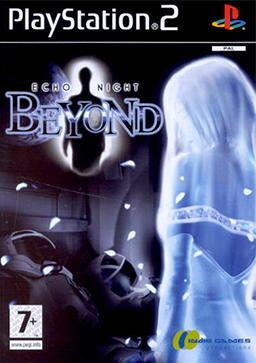
Since last week I went with a very well known title in horror gaming, I figured I'd go for something a little bit more obscure, and a bit more mellow. In fact, this odd futuristic ghost story is more sorrowful than anything else. That doesn't mean it's without it's freakier moments, but the gameplay in this title doesn't have all the big action sequences of other titles. It's also the third in the Echo Night series, so if you're familiar with those, you should know what to expect.
In Echo Night: Beyond, you play Richard Osmond, a passenger on a space shuttle heading to a small lunar base. His fiance, Claudia, lives there, and it's their intention to marry once he arrives. But things don't go according to plan. His shuttle crash lands, colliding with the very place you're trying to get. Richard awakens to find himself alone in the wrecked shuttle. He decides to grab a spacesuit and enter the base to find Claudia.
Unfortunately for Richard, it appears everyone inside the base is dead, the power is out, and ghosts are wandering the halls. To progress in the story, you'll have to find various items and appease the wandering spirits so that their souls get released from this mortal coil. To do this, you'll have to talk to them, which is a bit unsettling as they tend to fade in and out depending on how close you are. There's also lots of backtracking in the game, which can become annoying, though much of the game takes place around a central junction, so nothing is ever terribly far away.
[img width=460 height=325]http://ps2media.ign.com/ps2/image/article/543/543209/echo-night-beyond-20040830043258046-000.jpg[/img]
So, you're wandering in the dark, there are corpses everywhere, and their ghosts are wandering around. Could it get worse? Well yes, actually. You see, there's a bizarre mist that has spread throughout the base, making ghosts that inhabit it hostile, and if they get near you for long enough, your heart rate will spike and you'll go into cardiac arrest. This means two things: every encounter can be fatal fast, and your only options are to run away. There's no camera to fight with, no proton packs, no nothing. Instead, you have to sneak past them and pray one doesn't find you.
Also, the game's first person view really adds to the tension here, because these ghosts just have to be near you. You don't have to see them, and likely you won't: as your heart rates goes up, your vision blacks out. It can be a harrowing experience to enter a room with one and suddenly scramble for the door, only to realize you can hardly see where you're going. And if you do see it, well...some of these things get downright creepy.
Still, ghosts register on film, so you can use the vast network of security cameras to watch their patterns and discover their routes, since most of them follow set paths. Note I said most: there's one ghost in particular that will stalk you throughout the game, and he knows when you're using a security camera. Whenever you look at him he's got a nasty habit of looking back at you.
[img width=635 height=445]http://image.com.com/gamespot/images/2006/051/918908_20060221_790screen001.jpg[/img]
And then there's the atmosphere: you'll spend a good chunk of the game wandering around with just a flashlight, though it's not as bad as when you wander outside in my opinion. Once outside, there's little gravity so you jump really far, and the lighting gets a bit odd. The first time outside, I nearly threw myself off a cliff into a crater. To make matters worse, there are quite a few jumping puzzles while outside, and you do still have to look out for spirits.
The lack of action might bother some players, so this game definitely isn't meant for everyone. But if you're a fan of the old point-and-click adventure gameplay or enjoyed titles like Penumbra or other first person horror games, such as Juggernaut, D, or Hellnight, this may be right up your alley. And as an added bonus, it saw release in all three major regions, so getting it shouldn't be too difficult. Just be aware that in Japan it's known as Nebula: Echo Night.
[img width=635 height=445]http://image.com.com/gamespot/images/2006/051/918908_20060221_790screen002.jpg[/img]
Here's the intro for you:
Silent Hill

I figured for the first one of these, I'd post a mainstay to the horror genre. If you're a fan of survival horror, I feel that you must try this game. I'm not going to say it's perfect(no game is), but what Silent Hill did was absolutely phenomenal. I've seen it referred to as "the scariest game of all time", and I feel this title still holds true today. Even if one absolutely detests the game, it should be easy to see the positive impact on the genre. Today the Silent Hill series is one of the two most easily recognized series in survival horror(the other being Resident Evil, of course).
Here's a very brief plot analysis:
"The plot focuses on Harry Mason as he searches for his daughter, Cheryl, who has disappeared following a car accident which left Harry unconscious. He finds Silent Hill to be largely abandoned, shrouded in a thick fog, snowing out of season, filled with monsters and being over taken by a hellish otherworld. As Harry scours the town, he begins learning about the history of Silent Hill and stumbles upon a cult ritual undertaken to bring a God to Earth."
Silent Hill plays entirely from a third-person perspective, with a mix of pre-set and controllable camera angles, depending on the location. Through certain sections of the game, Harry's flashlight is the only lighting, but this has a double effect of also attracting monsters. A radio that Harry has emits static whenever a monster is near, serving as the only means to know when something is approaching.
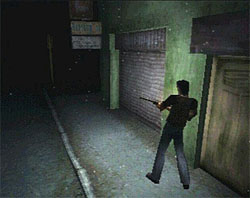
And then there's the other world. The only real way to describe it is Hell on Earth. There's all kinds of disturbing imagery and audio. To add to it, the developers were influenced and made reference to many other works of horror, fantasy, music, literature, film, and so on. Here's Wikipedia's list of influences and references:
* The surname of Lisa Garland is taken from the actress Judy Garland, Cheryl Mason's first name is based on Twin Peakss actress Sheryl Lee, Michael Kaufmann is a combination of Troma Studios producers' Lloyd Kaufmann and Michael Herz and both Alessa (originally named Asia) and Dahlia (originally named Daria) are names derived from relatives (daughter and former wife respectively) of Italian filmmaker Dario Argento.
* On the side of a garage door near the gas station is painted in blood with the word "REDRUM" painted on it in reference to The Shining.
* Some of the creatures and puzzles were named or designed with the books Alessa was fond of in mind, such as The Lost World and Alice's Adventures in Wonderland.
* The names originally intended for the characters of Harry and Cheryl were "Humbert" and "Dolores," the narrator and title character of Lolita. The American staff altered the names, given that the names were uncommon.
* At the beginning of the game there is a sign that says Bates Motel, which is a reference to Norman Bates' motel from Alfred Hitchcock's 1960 film Psycho.
* In "normal" version of the Midwich Elementary School one can find a list of teachers. The teachers listed are K.Gordon, T. Moore, L. Ranaldo, and S. Shelley. These names all refer to Kim Gordon, Thurston Moore, Lee Ranaldo, and Steve Shelley of the rock band Sonic Youth.
* The names of the streets are taken from various science fiction and horror novels or writers, such as Bradbury Street, Bachman Road, Matheson Street, and Midwich Street. These refer to Ray Bradbury, Richard Bachman, Richard Matheson, and The Midwich Cuckoos.
[img width=480 height=360]http://www.psu.com/media/articles/psu_champions_silenthill/silent_hill_1.jpg[/img]
Not bad for a game that was labeled a "Resident Evil clone" before its release. And while it did borrow a few things from Resident Evil in terms of gameplay(which had in turn borrowed from Alone in the Dark), its themes were its own and what it added to the Resident Evil formula helped distance it from the pack of RE-wannabes. Gone were the days of playing a well-trained police officer fighting with superior firepower against an enemy that has, frankly, become campy and overused. Instead, you play an everyman character, someone not proficient with a gun, or able to sprint long distances. Just an average guy.
Also gone was the setting, a plague of science run amok in the real world, something that could be blown away to restore the normal order. In Silent Hill we begin questioning what normal really meant. The trouble in Silent Hill couldn't be shot, stabbed, or beaten to death, because the trouble was with reality. This was normalcy in Silent Hill, at least in our heads. And while the creatures Harry encountered could be killed, there's some suggestion in the series that they weren't monsters at all, depending on who looked at them. And perhaps that's the biggest difference between the two:
Resident Evil gets in your blood. Silent Hill violates your mind.
Please, take a moment and check out the intro:
Hey fellas, Ack here. I'm using this introduction to explain a bit about what I'd like to talk about, as well as teaching myself the blogging software here.
And now...picture break!

Ok, glad I understand how that works. And yes, that is a map of Silent Hill.
Anyway, I'm Ack, and I like video games. I especially like video games with horror themes, though I do play a lot of other stuff, so please don't think I'm a one-trick pony. I just happen to have a soft spot in my heart for games that terrify me when I play them in the dead of night.
In fact, horror games have given me some of my favorite gaming memories. Resident Evil 2 was my first...I remember sitting up in a little hole-in-the-wall game room in my stepmom's house in Maine, controller gripped tightly in my hands, eyes wide at the carnage in front of me. We went out to dinner that night, and on the way back I kept glancing out the windows into the pitch-black woods wondering if zombies were really out there. Were they? Were they coming for me? I didn't sleep well for days. I didn't realize it until later that this had been one of those little gaming epiphanies, where you suddenly realize just how powerful the medium can be. But I digress.
I've discovered over the years that a lot of people avoid this genre because it terrifies them far more than any movie or book, likely because in this medium they have the power to control the so-called "victim," the player character, though they're still confined to the game's rules. But there are some folks who rise to the challenge, who subject themselves to this sheer, unadulterated terror, who sit up late into the night while playing Silent Hill, palms sweaty, hair unkempt, fear in their eyes. It is for these people that I'm doing this article: I'm giving them a list of nightmares, with some discussion of mechanics, a few screenshots, and sometimes a few insights of my own on the game.
Or maybe I'm just overthinking this, and some folks just want to play some games.
Either way, I'll be focusing on an individual game each post, following a thing I did over at the Racketboy.com forums, where I talked about one game each day for October. In fact, some of my earlier posts will likely just be straight ports of that material, if only to give me a platform to springboard off of with original content once October is over.
And if you have requests, such as you've heard of a particular title and want to know more, or think that certain games should be discussed, or you just want to know the thoughts of myself and the rest of the folks here at RFGeneration, post it in the comments! It's the best way to have a conversation.
|
|
|
This is Ack's Blog.
View Profile | RSS  |
|
This blog is about horror games. The good ones, the bad ones, and the ugly ones. And the obscure ones. The point of this is to educate, both the reader and the writer. Because I love horror games, and I love learning about them. |
|
Blog Navigation
Browse Bloggers | My Blog
|
|
Hot Entries
|
|
Hot Community Entries
| |
|